Animal Guides / Insects and small wonders
Tardigrades (water bears)
Microscopic eight-legged animals that can survive drying out, freezing, radiation and even open space by shutting down into a "tun" state.
Quick facts
| Fact | Detail |
|---|---|
| Group | Phylum Tardigrada, more than 1,300 described species |
| Class | Several classes; not insects or arthropods, though related to them |
| Diet | Plant cells, algae, bacteria and tiny animals such as nematodes, depending on species |
| Size | Usually about 0.1 to 0.5 mm; the largest reach around 1.2 to 1.5 mm |
| Lifespan | Active life of a few months to a couple of years; time in the dried state can extend this |
| Range | Worldwide: mosses, lichens, leaf litter, soil, fresh water, the ocean floor, from mountains to the deep sea |
Habitat
Tardigrades live almost everywhere there is at least a film of water. The easiest place to find them is in moss and lichen growing on walls, roofs and tree trunks. Others live in sand grains on beaches, in freshwater ponds, in soil and on the seafloor. Their nickname, water bears, comes from their plump bodies and slow, lumbering walk.
Body and behavior
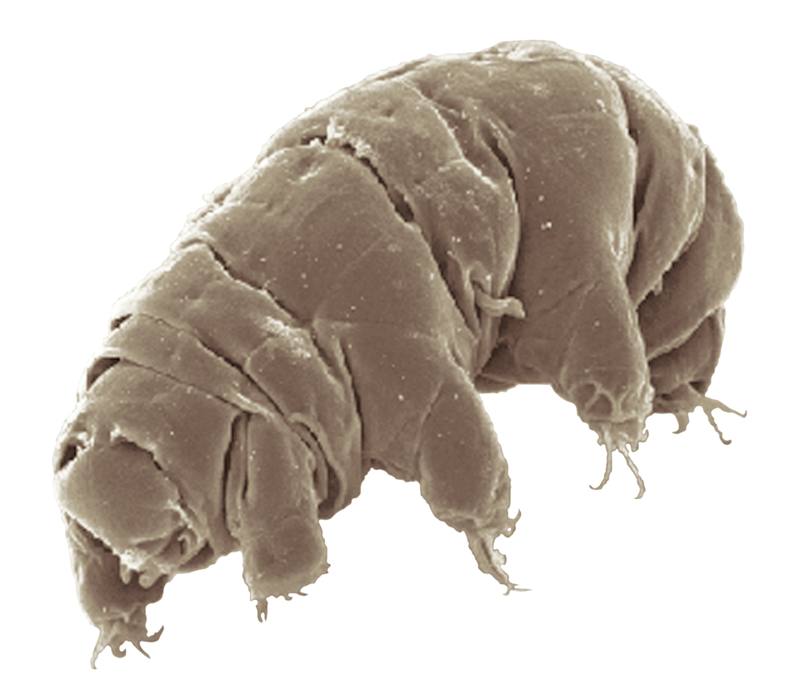
A tardigrade has a short, segmented body with four pairs of stubby legs ending in claws or sticky discs. It has a simple brain, a mouth with sharp stylets for piercing plant or animal cells, and a gut. Many species can be seen with a basic microscope or a strong magnifier.
Tardigrades move through the water film around moss leaves, feeding and laying eggs. Some species lay eggs inside their old shed skin. Some reproduce sexually, others without males.
The tun: how they survive extremes
When their habitat dries out, many tardigrades curl up, pull in their legs, lose almost all their body water and enter a state called anhydrobiosis, a form of cryptobiosis. In this shrunken "tun" state, their metabolism becomes almost undetectable. When water returns, they can rehydrate and walk away within minutes to hours.
| Extreme | What tardigrades in the tun state have survived in experiments |
|---|---|
| Cold | Temperatures close to absolute zero |
| Heat | Brief exposure to temperatures well above boiling |
| Radiation | Doses far higher than those that would kill a person |
| Space | In 2007, tardigrades flown on a European Space Agency experiment survived exposure to the vacuum of space; some also survived solar UV |
| Time | Specimens revived from moss stored dry for years; tardigrades frozen in Antarctic moss for about 30 years were revived and reproduced |
Scientists have found special proteins that help. One, called Dsup ("damage suppressor"), helps protect DNA from radiation damage. Others form a glass-like gel inside cells as they dry, holding delicate molecules in place.
Myths and limits
Tardigrades are indestructible. In reality, active tardigrades are fragile, and many survival records apply only to animals in the tun state, for limited times. Most do not survive every extreme, and results vary by species.
Tardigrades also are not "extremophiles" in the usual sense. They do not thrive in extreme conditions; they endure them, waiting for normal conditions to return.
Surprising facts
- Tardigrades were first described in 1773.
- Their closest relatives are thought to be arthropods (insects, spiders, crustaceans) and velvet worms. Learn how groups like phyla fit together in taxonomy explained.
- You can look for them yourself: soak a bit of dry moss in water overnight in a dish, then squeeze it and check the water under a microscope at around 30 to 50x magnification.
Collect only a small pinch of moss from a common source, such as a wall or path, and return the moss outdoors afterward.