Blue whale
The largest animal known to have ever lived, longer than a basketball court and fed almost entirely by tiny krill. Here is how a giant survives on the smallest prey.
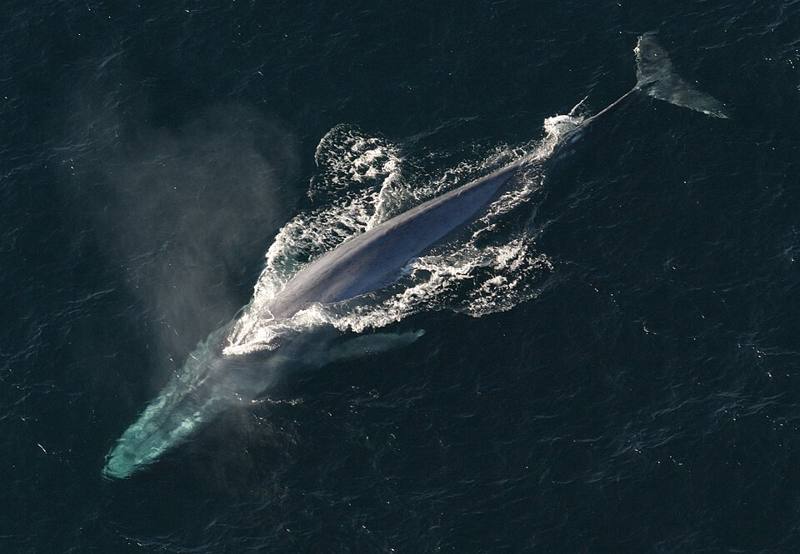
Quick facts
| Fact | Detail |
|---|---|
| Scientific name | Balaenoptera musculus |
| Class | Mammalia (mammals) |
| Diet | Filter feeder: mainly krill (small shrimp-like crustaceans) |
| Size | Commonly 24 to 30 m long; heaviest individuals estimated at well over 150 tonnes |
| Lifespan | Estimated 70 to 90 years |
| Range | All major oceans except the high Arctic |
| IUCN status | Endangered |
Habitat
Blue whales live in every major ocean. Many populations migrate between cold, food-rich feeding areas near the poles in summer and warmer waters at lower latitudes in winter, where calves are born. Some populations, such as the pygmy blue whales of the Indian Ocean, do not follow this pattern as strictly. Well-known places to see them include the coast of California, Sri Lanka, the Gulf of California and the Azores.
Behavior
A blue whale is a baleen whale. Instead of teeth, it has rows of baleen plates made of keratin, the same material as fingernails. To feed, it lunges into a swarm of krill with its mouth wide open, and pleated grooves on its throat expand like an accordion to take in an enormous gulp of water. It then pushes the water out through the baleen, trapping the krill. An adult may eat several tonnes of krill a day during the feeding season.
Blue whales are mostly seen alone or in pairs. They are fast swimmers for their size and dive for about 10 to 20 minutes at a time, though they usually feed in the upper few hundred meters of the ocean.
Their calls are among the loudest sounds made by any animal. These low-frequency moans and pulses are below or at the edge of human hearing and can travel hundreds of kilometers through water.
Size in perspective
| Comparison | Blue whale |
|---|---|
| Length | Longer than a basketball court (28 m) in the largest individuals |
| Heart | Roughly the weight of a small motorcycle; a preserved heart from Canada weighed about 180 kg |
| Calf at birth | About 7 m long and around 2.5 tonnes |
| Calf growth | Can gain around 90 kg a day while nursing |
Surprising facts
- The blue whale is larger than any known dinosaur, though some long-necked dinosaurs may have been longer.
- Its blow, the spout of breath when it surfaces, can rise around 9 meters.
- Each population sings in its own style, and researchers have recorded the pitch of blue whale songs slowly dropping over decades.
- Despite their size, blue whales eat some of the smallest animals in the ocean. See migration explained for why they travel so far to find them.
Threats and conservation
Commercial whaling in the 20th century killed hundreds of thousands of blue whales, especially in the Antarctic, and pushed the species close to extinction. Hunting was banned internationally in 1966, and some populations are slowly recovering, but numbers remain a small fraction of what they once were. Today the main threats are collisions with ships, entanglement in fishing gear, underwater noise and changes in krill supply linked to climate change. Some shipping lanes off California and Sri Lanka have been adjusted or slowed to protect whales.
Krill feed on tiny algae, and whale poop helps fertilize those algae by bringing nutrients to the surface. Recovering whales may help boost ocean productivity.