Octopus
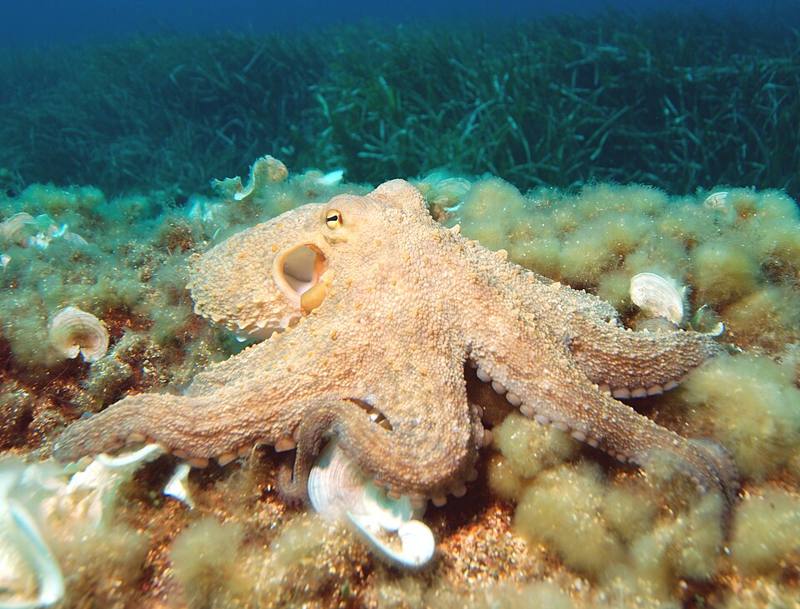
Three hearts, blue blood, and arms that can taste and think for themselves. The common octopus is one of the most intelligent invertebrates on Earth.
Quick facts
| Fact | Detail |
|---|---|
| Scientific name | Octopus vulgaris (common octopus); about 300 octopus species exist |
| Class | Cephalopoda (a group of mollusks, related to snails and clams) |
| Diet | Carnivore: crabs, shrimp, clams, snails and fish |
| Size | Typically up to about 1 m across including arms, and usually a few kilograms |
| Lifespan | Usually about 1 to 2 years |
| Range | Coastal waters of the Atlantic and Mediterranean; similar species worldwide |
| IUCN status | Not listed here: octopus species have rarely been assessed, and the common octopus is now thought to be a group of closely related species |
Habitat
Common octopuses live on rocky reefs, seagrass beds and sandy bottoms from shallow tide pools down to around 200 meters. Each octopus uses a den: a crevice, a gap under a rock, an empty shell or even a discarded bottle. You can often spot a den by the pile of empty crab and clam shells outside it, called a midden.
Behavior
Octopuses are solitary hunters that forage mostly at dawn, dusk or night. They search with their arms, probing into holes and under rocks, and can drill into shells using a toothed tongue called a radula, then inject saliva that weakens the prey.
Their skin is a living display screen. Thousands of chromatophores, small elastic sacs of pigment controlled by muscles, let an octopus change color in a fraction of a second. Other skin cells reflect light, and tiny muscles raise bumps called papillae, so the animal can change texture too. Octopuses use this for camouflage and also to signal.
When threatened, an octopus can shoot out a cloud of ink and jet away by squirting water through its siphon. Because it has no bones, an octopus can squeeze through any gap bigger than its beak, the only hard part of its body.
How an octopus body works
| Feature | What it does |
|---|---|
| Three hearts | Two pump blood through the gills; one pumps it around the body |
| Blue blood | Uses copper-based hemocyanin to carry oxygen, instead of iron-based hemoglobin |
| Distributed brain | About two-thirds of its neurons are in the arms, which can explore and react semi-independently |
| Suckers | Each arm has hundreds, packed with chemical receptors that let the octopus taste what it touches |
Surprising facts
- In aquariums, octopuses have been recorded escaping tanks, unscrewing jar lids and squirting water at lights or people they dislike.
- Veined octopuses in Indonesia carry coconut shell halves around and assemble them into shelters, one of the clearest examples of tool use in invertebrates. Read more in animal intelligence.
- Most octopuses breed only once. A female guards her eggs for weeks or months without eating and usually dies soon after they hatch.
- Octopuses are thought to be largely colorblind, yet match colors brilliantly. Scientists are still working out how.
Octopuses and people
Octopus is an important food in many coastal cultures, and some stocks are heavily fished. Because of evidence that octopuses can feel pain and learn, the United Kingdom recognized cephalopods as sentient beings in animal welfare law in 2022, and proposals to farm octopuses commercially have been widely criticized by scientists and welfare groups.
The plural of octopus is octopuses (or the less common octopodes). "Octopi" is widely used but is based on a mistaken Latin ending.