Animal Guides / Reptiles and amphibians
Axolotl
A smiling salamander that never grows up and can regrow lost limbs. Common in aquariums, but Critically Endangered in its only wild home.
Quick facts
| Fact | Detail |
|---|---|
| Scientific name | Ambystoma mexicanum |
| Class | Amphibia (amphibians) |
| Diet | Carnivore: worms, insect larvae, small crustaceans, snails and small fish |
| Size | Usually about 15 to 30 cm long |
| Lifespan | Often 10 to 15 years in captivity |
| Range | Wild only in the canals of Xochimilco, in southern Mexico City |
| IUCN status | Critically Endangered |
Habitat
Axolotls once lived in two highland lakes in the Valley of Mexico: Lake Xochimilco and Lake Chalco. Chalco was drained, and most of Xochimilco was lost as Mexico City grew. Today wild axolotls survive only in the remaining canals and ponds of Xochimilco, where the water is cool, slow-moving and full of plants. Surveys over recent decades have found steep declines in their numbers.
Behavior
Axolotls are mostly active at night, walking along the bottom or hovering in the water and sucking in prey with a sudden gulp. They have small teeth but mainly swallow food whole. In the wild, they hide among plants and mud during the day.
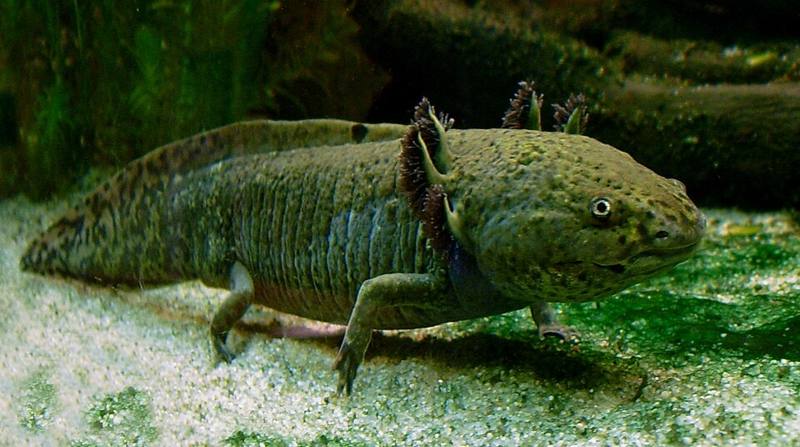
The axolotl's most famous trait is neoteny: it keeps juvenile features its whole life. Most salamanders hatch as aquatic larvae and then change into land-living adults. Axolotls stay aquatic, keep their feathery external gills and a fin along the back, and still become able to breed. Under unusual conditions, such as hormone treatment, an axolotl can be forced to change into a land form, but this is stressful and shortens its life.
The regeneration champion
Axolotls can regrow lost limbs, tail, parts of the spinal cord, and even parts of the heart, eyes and brain, usually without scar tissue. When a limb is lost, cells at the wound form a structure called a blastema, which rebuilds the missing part with bones, muscles and nerves in the right places. Researchers around the world study axolotls to understand how this works and whether it could someday help human medicine.
Axolotls as pets
Axolotls are popular aquarium animals, and almost all pet axolotls are captive bred. If you are considering one:
- They need cool water, ideally around 16 to 18 degrees Celsius (60 to 64 degrees Fahrenheit). Warm water stresses them.
- Use a fully cycled tank. Our aquarium fish basics guide explains the nitrogen cycle.
- Avoid gravel they could swallow. Bare-bottom tanks or fine sand are safer.
- Do not keep them with fish that nip their gills.
- Check local laws: keeping axolotls is restricted or requires permits in some places, including some US states and Canadian provinces.
Threats and conservation
Wild axolotls are threatened by water pollution, urban development, introduced fish such as tilapia and carp that eat young axolotls and compete for food, and changes to the canals. Conservation projects in Xochimilco work with local farmers who use the traditional chinampa system of floating gardens, creating clean-water refuges with filters that keep out invasive fish.
Pet axolotls come in colors such as pink (leucistic), gold and white, but wild axolotls are usually dark brown or olive with speckles, which helps them hide.
Learn how scientists define Critically Endangered in our IUCN categories guide.