Animal Guides / Reptiles and amphibians
Chameleons
Lizards with swiveling eyes, a lightning-fast tongue and color-changing skin, but they change color more to communicate than to hide.
Quick facts
| Fact | Detail |
|---|---|
| Group | Family Chamaeleonidae, with over 200 species |
| Class | Reptilia (reptiles) |
| Diet | Mostly insects and other invertebrates; large species also take small vertebrates |
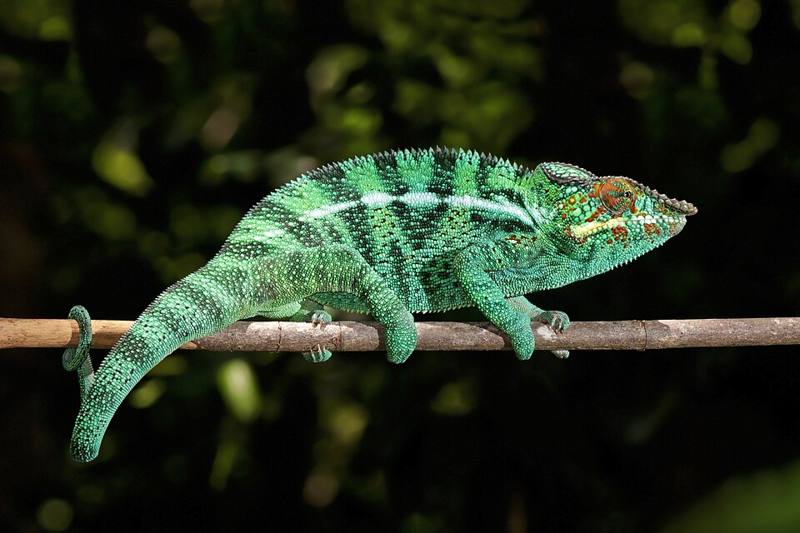
| Size | From about 2 to 3 cm (tiny Brookesia species) to around 60 to 70 cm (Parson's chameleon and others) |
| Lifespan | From about a year in some small species to around 5 to 10 in larger ones |
| Range | Africa, Madagascar, southern Europe, the Middle East and South Asia |
| IUCN status | Varies by species; several Madagascar species are threatened |
Habitat
Roughly half of all chameleon species live on the island of Madagascar, and many are found nowhere else. Others live across mainland Africa, with a few species around the Mediterranean, the Arabian Peninsula and into India and Sri Lanka. Most chameleons live in trees and bushes, though some small species live in leaf litter on the forest floor.
Behavior
Chameleons are slow, deliberate movers. They sway as they walk, which may help them look like a leaf moving in the breeze. They grip branches with feet in which toes are fused into two opposing bundles, like tongs, and many species also use a curling, grasping tail.
Most chameleons live alone and defend their space. Males of many species display to rivals and females with bright colors, puffed-up bodies and head bobs.
Color change explained
The old idea that chameleons change color to match any background is a myth. Their colors shift mainly to:
- Communicate: brighter colors in contests between males or during courtship; darker or duller colors to signal stress or that a female is not receptive.
- Control temperature: darker skin absorbs more heat in the morning.
- Blend in: their resting colors are often camouflaged, but they do not copy patterns like a checkerboard.
Research published in 2015 on panther chameleons showed that color change works partly by adjusting a lattice of tiny guanine nanocrystals in skin cells called iridophores. Relaxing or tightening the spacing of these crystals changes which colors of light are reflected. Pigment cells add further colors on top. Compare this with the octopus method in camouflage explained.
Eyes and tongue
- Eyes: each eye sits in a cone-shaped turret and can move independently, so a chameleon can look in two directions at once. When it spots prey, both eyes lock forward for precise depth judgment.
- Tongue: the tongue can shoot out more than the length of the chameleon's body in a fraction of a second. Its tip is sticky and muscular, and the launch works like a spring, using elastic tissue that stores energy before release. Smaller species have relatively faster tongues.
Surprising facts
- One of the smallest known reptiles, Brookesia nana from Madagascar, was described in 2021; adult males are under 2.5 cm long including the tail.
- Many chameleons glow under ultraviolet light because of bony bumps on the skull that fluoresce.
- Chameleons do not hear well in the usual sense but can pick up low-frequency vibrations.
Threats and conservation
Many chameleons have tiny ranges, so forest clearing can threaten whole species. The international pet trade has also taken large numbers from the wild, and some species are now covered by CITES trade controls. If you keep a chameleon, choose a captive-bred animal and make sure you can provide the right heat, UV lighting, humidity and live insect food. See choosing the right pet.