Animal Guides / Big cats and predators
Lion
The only truly social big cat, living in family prides on the African savanna. Here is how lions hunt, raise cubs and why their numbers have fallen.
Quick facts
| Fact | Detail |
|---|---|
| Scientific name | Panthera leo |
| Class | Mammalia (mammals) |
| Diet | Carnivore: zebra, wildebeest, buffalo, antelope and other large prey |
| Size | Males about 150 to 250 kg; females about 120 to 180 kg |
| Lifespan | About 10 to 14 years in the wild; up to about 20 in zoos |
| Range | Sub-Saharan Africa; a small population of Asiatic lions in Gir Forest, India |
| IUCN status | Vulnerable |
Habitat
Lions are animals of open country. They do best on grassy plains, open woodland and scrub where herds of grazing animals gather, and where there is enough cover (tall grass, bushes, riverbeds) to stalk close before a charge. They avoid dense rainforest. Some populations, such as those in the Kalahari, survive in very dry areas by getting much of their moisture from prey.
Lions once ranged across most of Africa, into southern Europe, the Middle East and India. Today wild lions are almost entirely limited to sub-Saharan Africa, plus a few hundred in and around India's Gir Forest. Many of Africa's remaining lions live in protected areas such as the Serengeti, the Okavango Delta region and Kruger National Park.
Behavior
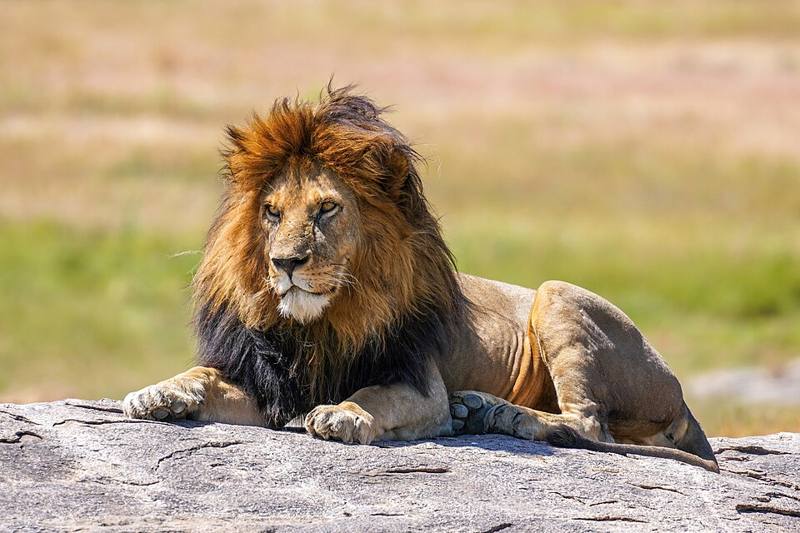
A pride is a family group, usually a core of related females, their cubs and one to a few adult males. Prides range from a handful of animals to more than 20. The females usually stay for life; young males are pushed out at around two to three years old and often roam in small coalitions until they can take over a pride of their own.
Lionesses do most of the hunting, often working together to surround prey or drive it toward hidden pride mates. Males defend the territory and the pride against rival males. A lion's roar can be heard several kilometers away and tells neighbors exactly who holds the land.
Lions spend a surprising amount of time doing nothing. Resting 16 to 20 hours a day is normal, because hunting big animals in the heat burns huge amounts of energy. Most hunting happens at night or around dawn and dusk.
When a new male coalition takes over a pride, the males may kill young cubs fathered by the previous males. This is grim but common, and it brings the females back into breeding condition sooner.
Surprising facts
- Lions are the only cats that regularly live in large social groups. Other big cats are mostly solitary. See how they compare in our tiger and cheetah guides.
- A darker, fuller mane tends to signal a healthier, stronger male, and research in Tanzania found lionesses prefer darker-maned males.
- Lions scavenge more than people expect. Where hyenas are common, lions often steal hyena kills, and hyenas steal from lions too.
- Lion cubs are born with faint spots, which usually fade as they grow.
- A male lion can eat a very large meal at once and then go several days without eating.
Threats and conservation
Lion numbers have dropped steeply over the last century. The main threats are loss of habitat as farmland expands, conflict with livestock owners when lions take cattle, and a shrinking supply of wild prey because of bushmeat hunting. Conservation projects that build predator-proof livestock enclosures, compensate herders for losses or employ local people as lion guardians have reduced killings in several areas. Learn what the Vulnerable label means in our IUCN categories guide.
The Asiatic lion of Gir Forest grew from a very small remnant population in the early 1900s to several hundred animals today thanks to long-term protection.