Animal Guides / Big cats and predators
Polar bear
The largest land carnivore, a marine mammal that hunts seals from Arctic sea ice. Learn how polar bears stay warm, how they hunt and why sea ice decides their future.
Quick facts
| Fact | Detail |
|---|---|
| Scientific name | Ursus maritimus |
| Class | Mammalia (mammals) |
| Diet | Carnivore: mainly ringed and bearded seals; also scavenges carcasses |
| Size | Adult males often about 350 to 700 kg; females roughly half that |
| Lifespan | Often 15 to 20 years in the wild; some reach 25 to 30 |
| Range | Arctic coasts and sea ice of Canada, the United States (Alaska), Russia, Greenland and Norway (Svalbard) |
| IUCN status | Vulnerable |
Habitat
Polar bears depend on sea ice. They spend much of the year on frozen ocean, especially areas where the ice meets open water or has cracks, because that is where seals come up to breathe. In summer, as the ice melts, many populations are forced ashore, where they live mostly off fat reserves until the ice returns in autumn.
Scientists divide the world's polar bears into about 19 subpopulations around the Arctic. Total numbers are usually estimated at roughly 22,000 to 31,000, but some subpopulations have never been fully surveyed.
Behavior
The classic polar bear hunt is still-hunting: waiting motionless beside a seal's breathing hole, sometimes for hours, then grabbing the seal when it surfaces. Bears also stalk seals resting on the ice and break into snow dens where ringed seals give birth. Seal blubber is the key food, because it delivers the high-energy fat the bears need to survive the cold and fast for long periods.
Polar bears are mostly solitary, except for mothers with cubs and short courtship periods. Pregnant females dig maternity dens in snowdrifts in autumn and give birth in midwinter. Cubs are tiny at birth, under a kilogram, and emerge with their mother in spring. They stay with her for about two and a half years.
Polar bears are strong swimmers and are classed as marine mammals in several countries' laws. They can swim for long distances between ice floes, and tracked females have swum for days without rest, though these marathon swims are dangerous for cubs.
Built for the cold
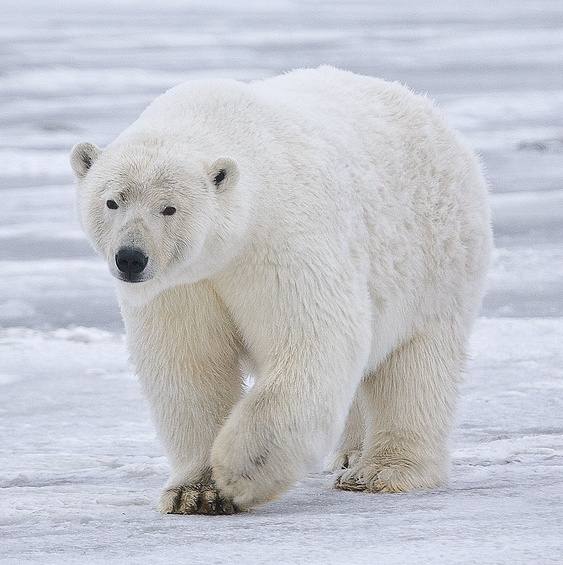
- Skin and fur: the skin is black, which absorbs heat. The outer guard hairs are not actually white; they are transparent and hollow, and look white because they scatter light.
- Fat: a thick layer of blubber insulates the body and stores energy.
- Feet: large paws spread weight on thin ice and work as paddles. Small bumps on the pads help grip.
- Small ears and tail: less exposed surface means less heat lost.
Surprising facts
- Polar bears are so well insulated that they can overheat when running.
- Brown bears and polar bears are closely related and occasionally interbreed in the wild.
- A polar bear's sense of smell lets it detect seals under snow cover from a long distance.
Threats and conservation
The main long-term threat to polar bears is the loss of Arctic sea ice as the climate warms. Shorter ice seasons mean less hunting time and longer fasts on land. In some well-studied subpopulations, such as Western Hudson Bay, scientists have recorded declines in body condition and numbers. Other pressures include pollution that builds up in Arctic food webs and conflict with people in coastal towns. Read what Vulnerable means in our IUCN categories guide.
In polar bear country, travel with trained local guides and follow all deterrent and food storage rules. Polar bears can see people as prey.