Animal Guides / Big cats and predators
Snow leopard
The ghost of the mountains, a smoky gray cat that lives high in the ranges of Central and South Asia. Here is how it survives cold, thin air and steep cliffs.
Quick facts
| Fact | Detail |
|---|---|
| Scientific name | Panthera uncia |
| Class | Mammalia (mammals) |
| Diet | Carnivore: blue sheep (bharal), ibex, marmots, pikas and other mountain animals |
| Size | About 22 to 55 kg; body around 1 to 1.3 m plus a tail nearly as long |
| Lifespan | About 10 to 12 years in the wild; often longer in zoos |
| Range | Mountains of Central and South Asia, including the Himalaya, Tibetan Plateau, Altai and Tian Shan |
| IUCN status | Vulnerable |
Habitat
Snow leopards live in steep, rocky, treeless mountain country, often between about 3,000 and 4,500 meters above sea level, and sometimes higher. In the far north of their range, in Mongolia and Russia, they can live at lower elevations. Their range stretches across twelve countries, with large areas in China, Mongolia, India, Nepal, Bhutan, Pakistan and the Central Asian republics.
This is some of the harshest habitat any cat uses: thin air, deep cold, little cover and prey spread thinly across enormous areas. Home ranges can be very large, and individual cats may travel many kilometers in a night along ridgelines and cliff bases.
Behavior
Snow leopards are solitary and mostly active at dawn and dusk. They stalk prey across broken rock, then leap and chase down steep slopes. Their main prey are wild goats and sheep such as bharal (blue sheep) and Siberian ibex, but they also catch smaller animals like marmots and pikas, especially in summer.
They communicate with scent marks, scrapes and sprays on rocks along regular travel routes. Researchers use those same routes to place camera traps, which is how most of what we know about these secretive cats has been learned.
Cubs are born in a rocky den, usually in late spring or early summer, and stay with their mother until they are around 18 to 22 months old.
Built for the cold
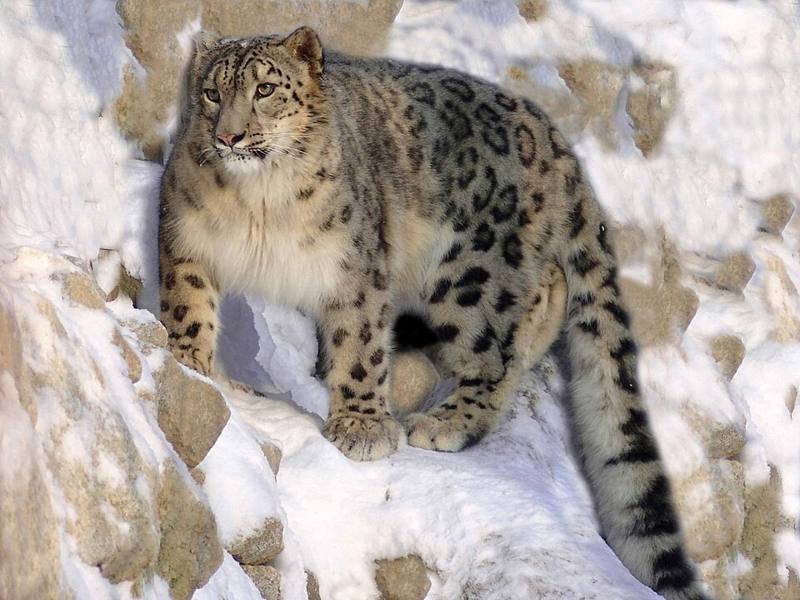
- The tail: thick and long, used for balance on cliffs and wrapped around the body and face like a scarf when resting.
- Big paws: wide, furry feet work like snowshoes and protect against cold rock.
- Short, powerful legs: snow leopards are known for long leaps across ravines and up ledges.
- Lungs and nose: a large nasal cavity warms cold air before it reaches the lungs.
- Coat: dense, smoky gray fur with dark rosettes blends almost perfectly into rock and snow. See camouflage explained.
Surprising facts
- Snow leopards cannot roar like a tiger. They make a puffing chuff, mews, growls and wails instead.
- They are so rarely seen that many researchers spend years in the field before seeing one in person.
- Despite the name, snow leopards are not especially closely related to the common leopard within the big cat family tree; their closest relative appears to be the tiger.
Threats and conservation
The species was moved from Endangered to Vulnerable in 2017 after a review of population data, but scientists stressed that numbers are still thought to be declining. Threats include poaching for fur and bones, retaliation killings when cats take livestock, loss of wild prey, and climate change pushing the tree line and farming higher up the mountains. Community programs that insure herders' livestock, build predator-proof corrals and support local livelihoods have reduced killings in several regions.
Snow leopard watching trips are growing in places like Ladakh in India. Choose operators that employ local guides and follow strict rules on distance and disturbance, as described in our responsible wildlife watching checklist.