Animal Guides / Big cats and predators
Tiger
The largest living cat, a solitary striped hunter of Asian forests and grasslands. Learn where tigers live, how they hunt and how protection is helping some populations recover.
Quick facts
| Fact | Detail |
|---|---|
| Scientific name | Panthera tigris |
| Class | Mammalia (mammals) |
| Diet | Carnivore: deer, wild pigs, wild cattle and other large prey |
| Size | Males roughly 180 to 300 kg depending on region; females smaller |
| Lifespan | About 10 to 15 years in the wild; longer in zoos |
| Range | South Asia, Southeast Asia, the Russian Far East and northeast China |
| IUCN status | Endangered |
Habitat
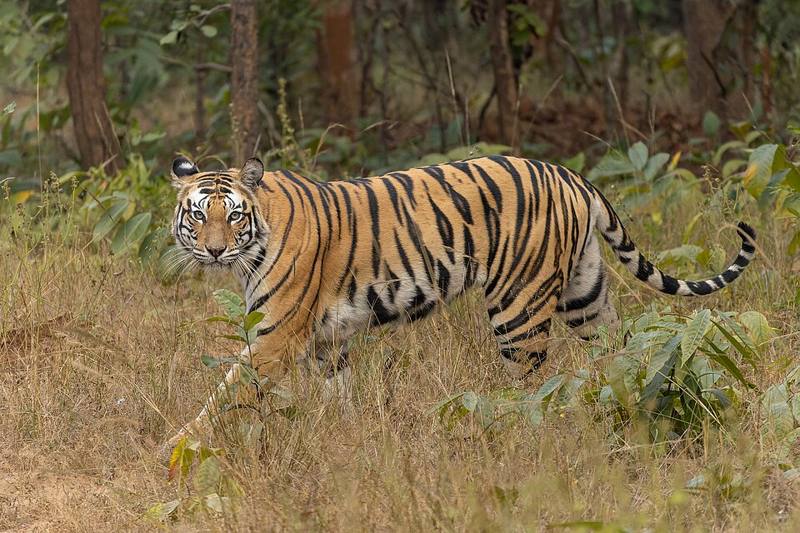
Tigers are flexible about habitat as long as three things are present: dense cover for stalking, water, and enough large prey. They live in tropical rainforest, mangrove swamps (the Sundarbans of India and Bangladesh), dry deciduous forest, tall grasslands and the snowy forests of the Russian Far East.
The tigers of the far north, often called Amur or Siberian tigers, are the largest and grow thick winter coats. Tigers on the island of Sumatra are the smallest. Scientists currently group living tigers into two subspecies: mainland tigers and Sunda Island tigers.
Behavior
Unlike lions, tigers live alone. Adults hold territories marked with scent sprays, scrapes and claw marks on trees. A male's territory usually overlaps the ranges of several females. Mothers raise cubs alone for about two years, teaching them to hunt before they leave.
Tigers are ambush hunters. They creep close using cover, then rush the last few meters and bring prey down with a bite to the throat or the back of the neck. Most attacks fail, so a tiger may go several days between meals and then eat a very large amount at once.
Tigers love water. They swim well, cool off in pools on hot days and will chase prey into rivers. This is unusual among cats.
Surprising facts
- No two tigers have the same stripe pattern, so researchers identify individuals from camera trap photos, much like fingerprints.
- The stripes are not just on the fur. The pattern also shows on the skin underneath.
- Stripes are excellent camouflage in tall grass and dappled forest light. Deer and many other prey animals see color differently from us, which makes an orange tiger even harder to spot. Read more in our camouflage guide.
- White tigers are not a separate species. They are Bengal tigers carrying a rare recessive gene, and most in captivity come from heavy inbreeding.
- Tigers roar, but they also make a soft, friendly puffing sound called chuffing.
Threats and conservation
A century ago there may have been as many as 100,000 wild tigers. Numbers fell to a few thousand because of hunting, the trade in tiger parts, and the loss and fragmentation of forest. Since around 2010, intensive protection has helped numbers rise in several countries, especially India and Nepal, and recent global estimates put the wild population at roughly 5,500. Tigers have, however, disappeared completely from several countries where they once lived.
Modern tiger conservation relies on patrols against poaching, protecting prey animals, keeping forest corridors open so tigers can move between reserves, and reducing conflict with villages. Learn how you can help in how to help wildlife.
Avoid any attraction that offers photos with tiger cubs or walks with tigers. Cub-petting operations often breed cats continuously for the tourist trade.