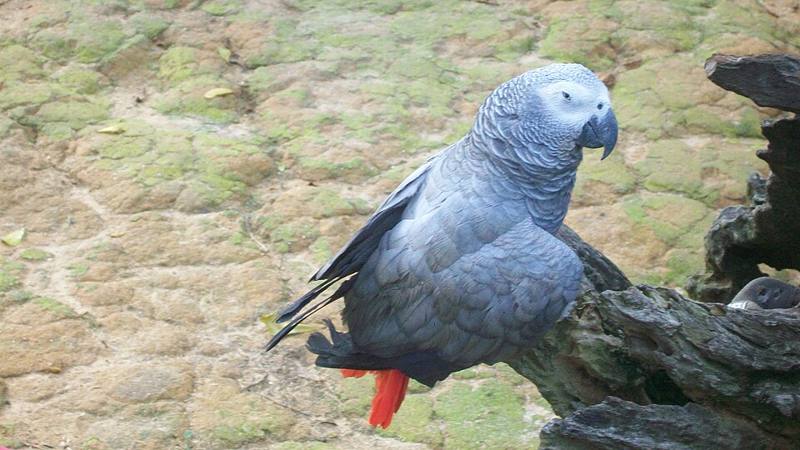
African grey parrot
Famous for talking and problem solving, the African grey is one of the smartest birds known, and one of the most threatened by the pet trade.
Quick facts
| Fact | Detail |
|---|---|
| Scientific name | Psittacus erithacus (grey parrot) |
| Class | Aves (birds) |
| Diet | Seeds, nuts, fruit (especially oil palm fruit), flowers and leaves |
| Size | About 33 cm long; around 400 to 500 g |
| Lifespan | Often 40 to 60 years in captivity; wild lifespan less well known |
| Range | Rainforests of west and central Africa |
| IUCN status | Endangered |
Habitat
Grey parrots live in lowland rainforest, forest edges, mangroves and wooded savanna across central Africa, from countries around the Gulf of Guinea east to Kenya. They roost communally in tall trees, sometimes in groups of hundreds or more, and fly out in noisy flocks each morning to feed. A closely related bird, the Timneh parrot of West Africa, used to be treated as the same species and is now usually considered separate.
Behavior
In the wild, grey parrots are highly social. They feed in flocks, call constantly to stay in contact and pair for long periods. They nest in tree cavities, often high up, and raise two to four chicks.
Wild grey parrots are not known to mimic human speech. Their remarkable vocal learning evolved to share calls with flock mates. In captivity, they apply that same skill to the sounds around them, including words, phone ringtones and microwave beeps.
Intelligence
African greys are a classic subject in animal cognition research. The best known study is the work of psychologist Irene Pepperberg with a grey parrot named Alex, beginning in the late 1970s. Alex learned to use more than 100 English labels for objects, colors, shapes and materials and could answer questions about them, such as which object was bigger or what color a particular item was. He also appeared to understand the idea of zero in counting tasks.
Other studies have shown grey parrots can solve puzzles, make inferences about hidden food, and, in some experiments, share tokens to help a partner. Read more about how scientists test animal minds in animal intelligence.
Grey parrots as pets
Because they are intelligent and long-lived, grey parrots are demanding companions:
- They need several hours a day of social contact and mental stimulation.
- Bored or lonely parrots can develop feather plucking and other stress behaviors.
- A parrot may outlive its owner, so plans for its future care matter.
- Only buy captive-bred birds from reputable breeders or adopt from parrot rescues.
See choosing the right pet before deciding if any parrot fits your household.
Threats and conservation
Grey parrots have been among the most heavily traded wild birds in the world. Huge numbers were caught from the wild for the pet trade, and many died in capture and transport. Combined with forest loss, this led to steep declines, and the species was listed as Endangered by the IUCN in 2016. The same year, it was moved to Appendix I of CITES, the treaty that regulates wildlife trade, which bans international commercial trade in wild-caught birds. Illegal trapping still happens in some areas.
Never buy a parrot without paperwork showing it was legally captive-bred. Demand for wild-caught birds keeps poaching alive.